
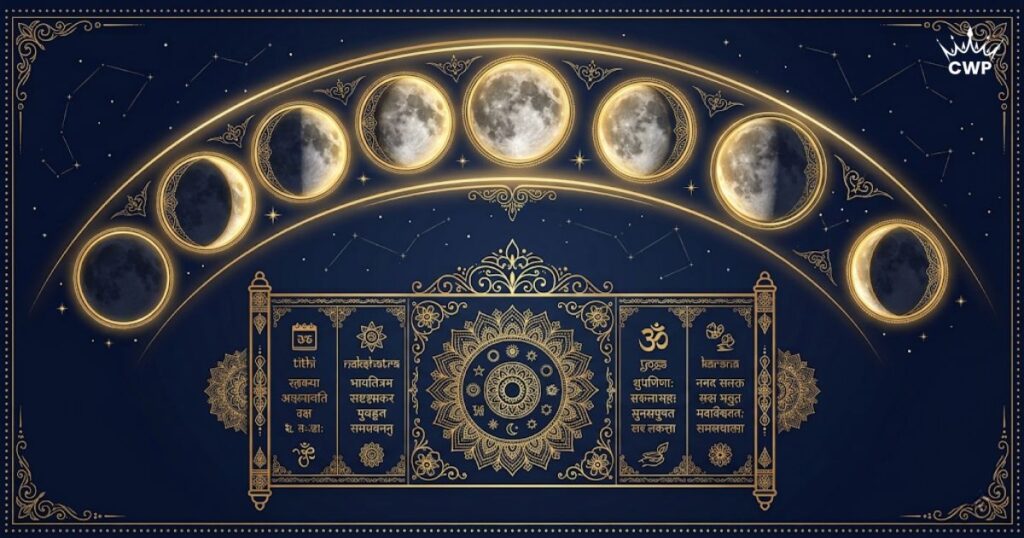
Related free tools: Aaj ka Daily Panchang aur Rahu Kaal & Choghadiya dekhein, apni city ke hisaab se.
“Aaj ki tithi kya hai?” is one of the most common questions Indians ask before a puja, vrat, or any auspicious work. The tithi decides everything from Ekadashi fasts to festival dates. But what exactly is a tithi, how is it calculated, and how do you check today’s tithi in seconds? This complete guide explains the tithi calendar in plain language, and shows you the fastest way to find aaj ki tithi for any day and any place.
What is a tithi?
A tithi is a lunar day in the Hindu calendar, the time the Moon takes to move 12° ahead of the Sun. A full lunar month is divided into 30 tithis. As the Moon gains 12° on the Sun, one tithi is completed; after 360° (a full cycle), the month restarts. Because the Moon does not move at a constant speed, a tithi can be a little shorter or longer than a 24-hour solar day, usually between about 19 and 26 hours.
This is the key difference between a tithi and an ordinary date: your calendar date changes at midnight, but a tithi changes whenever the Sun–Moon angle crosses the next multiple of 12°, which can happen at any time of day or night.
The two pakshas and the 30 tithis
The lunar month has two halves (paksha):
- Shukla Paksha, the bright, waxing fortnight from new moon to full moon (tithis 1-15, ending in Purnima).
- Krishna Paksha, the dark, waning fortnight from full moon to new moon (tithis 1-15, ending in Amavasya).
The 15 tithi names, used in both pakshas, are: Pratipada, Dwitiya, Tritiya, Chaturthi, Panchami, Shashthi, Saptami, Ashtami, Navami, Dashami, Ekadashi, Dwadashi, Trayodashi, Chaturdashi, and then Purnima (full moon) in Shukla Paksha or Amavasya (new moon) in Krishna Paksha.
How is “aaj ki tithi” decided?
The tithi for the day is the one prevailing at sunrise. In Hindu tradition, the tithi that is running when the Sun rises is treated as that day’s tithi for vrats and festivals, even if it changes to the next tithi a few hours later. This is why the same tithi can appear on your calendar for a whole day, while its actual ending time might be in the morning, afternoon or late night.
Because it is tied to sunrise, the tithi of the day can differ slightly by location. That is also why a good tithi calendar shows both the tithi at sunrise and the exact time it ends.
Tithi Kshaya and Tithi Vriddhi: when a tithi is skipped or repeated
Since a tithi can be shorter or longer than a solar day, two special situations arise:
- Tithi Kshaya (lost tithi): if a short tithi begins and ends between two sunrises, never touching a sunrise, it is skipped on the calendar. That day appears to “jump” a tithi.
- Tithi Vriddhi (extra tithi): if a long tithi is present at two consecutive sunrises, it is counted on both days, the same tithi appears twice.
A well-built tithi calendar reflects both of these exactly the way a traditional panchang does, so you never miss a vrat or observe it on the wrong day.
Why the tithi matters
- Fasts and vrats: Ekadashi, Pradosh (Trayodashi), Chaturthi (Sankashti/Vinayaka) and Ashtami vrats are all tied to specific tithis.
- Festivals: Diwali (Amavasya), Raksha Bandhan (Purnima), Janmashtami (Ashtami), Maha Shivratri (Chaturdashi), each is fixed to a tithi, not a Gregorian date.
- Muhurat: auspicious tithis (like Nanda, Bhadra, Jaya, Rikta, Purna groups) guide when to start important work.
How to check aaj ki tithi in seconds
You do not need to calculate anything by hand. Open the free Tithi Calendar and you will instantly see:
- Tithi at sunrise, today’s official tithi and paksha, with the time it ends.
- Tithi right now, the tithi active at this very moment.
- A full month grid with the moon phase for every day, plus Amavasya and Purnima dates.
- Tap any date for a detailed panchang, nakshatra, yoga, karana, the tithi’s deity, and sunrise/sunset.
It is calculated astronomically from the real positions of the Sun and Moon, so the timings are accurate to the minute.
Conclusion
A tithi is the heartbeat of the Hindu calendar, a lunar day set by the dance of the Sun and Moon, not by the clock on your wall. Once you understand pakshas, the 30 tithis, and how the sunrise tithi is chosen, checking “aaj ki tithi” becomes effortless. Bookmark the free Tithi Calendar for daily use, and for personalised muhurat or your horoscope, consult AstroLogic Digital.
Frequently Asked Questions
What is the tithi today?
Today’s tithi is the lunar day prevailing at sunrise. The quickest way to check it is the free Tithi Calendar, which shows the tithi at sunrise, the tithi right now, and the exact time it ends.
How is a tithi different from a normal date?
A calendar date changes at midnight, but a tithi changes whenever the Moon gains another 12° on the Sun, which can be at any time of day. A tithi is also usually not exactly 24 hours long, so it can be shorter or longer than one date.
Why is a tithi sometimes repeated or skipped?
If a short tithi begins and ends between two sunrises it is skipped (Tithi Kshaya). If a long tithi is present at two sunrises it is counted on both days (Tithi Vriddhi). A proper tithi calendar shows both correctly.
Is the tithi the same everywhere in India?
The tithi itself is the same worldwide at any given moment, but the “tithi of the day” depends on your local sunrise, so it can differ by a day near the boundaries. That is why timings are shown in IST and confirmed against a local panchang.