
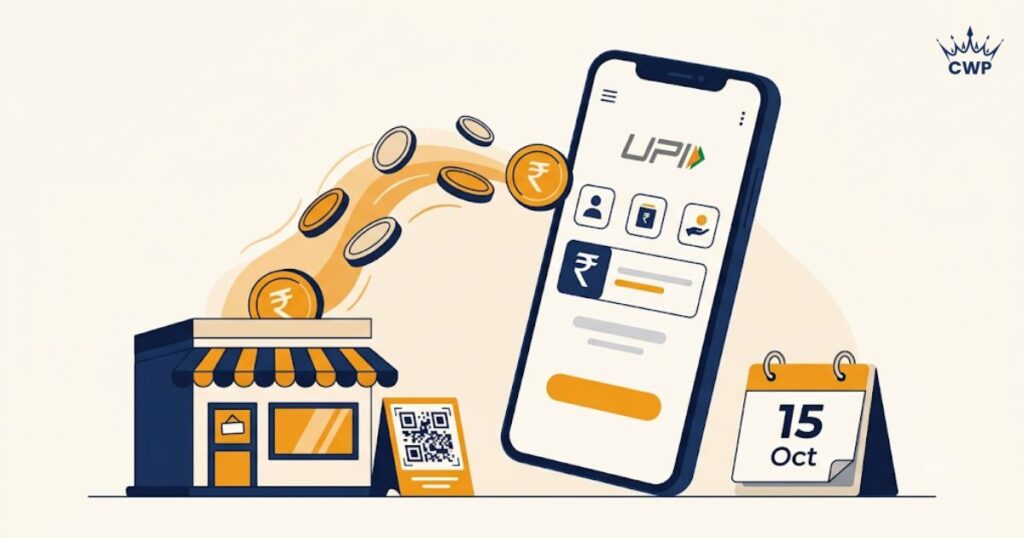
From 15 October 2026, a new MDR (Merchant Discount Rate) framework introduces UPI charges on certain high-value merchant payments. The good news for everyday users: customers will not pay anything extra, and small merchants stay exempt. This is a merchant-side charge on larger business transactions. Here is exactly what is changing, who pays, and what it means if you run a small business or freelance and accept UPI. If you invoice clients, our free Invoice Generator and GST Calculator can help you plan.
What are the new UPI charges?
From 15 October 2026, an MDR of 0.4% applies to eligible person-to-merchant (P2M) UPI transactions above 2,000 rupees, capped at 300 rupees for transactions of 75,000 rupees and above. Person-to-person (P2P) transfers and merchant payments up to 2,000 rupees stay completely free. The charge is paid by the merchant, not the customer.
New UPI charges 2026: full breakdown
| Transaction type | Charge (MDR) |
|---|---|
| Person-to-person (P2P) transfers | Free (no charge) |
| Merchant payments up to 2,000 | Free (zero MDR) |
| Merchant payments above 2,000 (standard) | 0.4% MDR |
| High-value payments of 75,000 and above | Capped at 300 |
| Railways, fuel, telecom, insurance (above 2,000) | Flat 5 per transaction |
| Capital markets (mutual funds, stocks) | 0.02% (max 300) |
Do customers have to pay UPI charges?
No. Ordinary customers continue to use UPI without any transaction fee. The MDR is charged to the merchant (the business receiving the payment), and the framework specifically bars merchants from passing this fee on to customers. So if you are a regular user sending money or paying a shop, nothing changes for you.
Who is exempt from the new UPI charges?
- All P2P transfers (sending money to friends or family) remain free.
- Merchant payments up to 2,000 rupees stay at zero MDR, which covers the vast majority of small everyday payments.
- Micro and small merchants receiving up to about 1 lakh rupees per month via UPI QR (the P2PM category) remain exempt.
So most small shopkeepers and small sellers are largely unaffected.
What it means for small businesses and freelancers
If you run a small business or freelance and receive larger UPI payments (above 2,000 rupees) as a registered merchant, a 0.4% MDR may apply to those transactions once you cross the small-merchant exemption. In practice:
- On a 10,000 rupee client payment, the MDR would be about 40 rupees.
- On a 50,000 rupee payment, about 200 rupees.
- On payments of 75,000 and above, it is capped at 300 rupees.
It is a small percentage, but if you handle high volumes, it adds up. Factor it into your pricing, and keep clean records. Our GST Calculator helps you price correctly, and the Invoice Generator keeps your billing professional.
How to prepare as a business owner
- Check your category: confirm with your bank or payment provider whether you fall under the exempt small-merchant limit.
- Review your pricing: for high-value services, account for the small MDR so your margin stays intact. See our guide on pricing your services.
- Do not pass it to customers: the rules prohibit charging customers extra, so build it into your rates instead.
- Keep GST and records tidy: read our GST guide for freelancers.
Background: a shift in policy
UPI has been free of MDR for years, with the government subsidising the cost to drive digital adoption. Earlier, officials had indicated there were no plans to levy MDR on UPI. This new framework marks a shift towards making the payments ecosystem financially sustainable in the long term, while protecting ordinary users and small merchants from any direct cost.
Source: New UPI MDR framework by NPCI, effective 15 October 2026, as reported by multiple financial news outlets. Figures are based on the announced framework; confirm the final details with your bank or payment provider before making business decisions.
Frequently Asked Questions
Will customers have to pay UPI charges from October 2026?
No. Ordinary customers continue to use UPI without any transaction fee. The MDR is a merchant-side charge, and the rules specifically prohibit merchants from passing it on to customers.
What is the new UPI MDR rate?
From 15 October 2026, a 0.4% MDR applies to eligible merchant (P2M) UPI transactions above 2,000 rupees, capped at 300 rupees for transactions of 75,000 rupees and above.
Are small businesses affected by the new UPI charges?
Small and micro merchants receiving up to about 1 lakh rupees per month via UPI QR remain exempt, and all merchant payments up to 2,000 rupees stay free. Only larger eligible merchant transactions attract the MDR.
Do person-to-person UPI transfers have any charge?
No. Person-to-person (P2P) transfers, such as sending money to friends or family, remain completely free under the new framework.
What are the UPI charges for railways, fuel and telecom?
Transactions above 2,000 rupees in sectors like railways, fuel, telecom and insurance attract a flat 5 rupees per transaction, while capital market transactions like mutual funds and stocks are charged 0.02% (up to 300 rupees).