
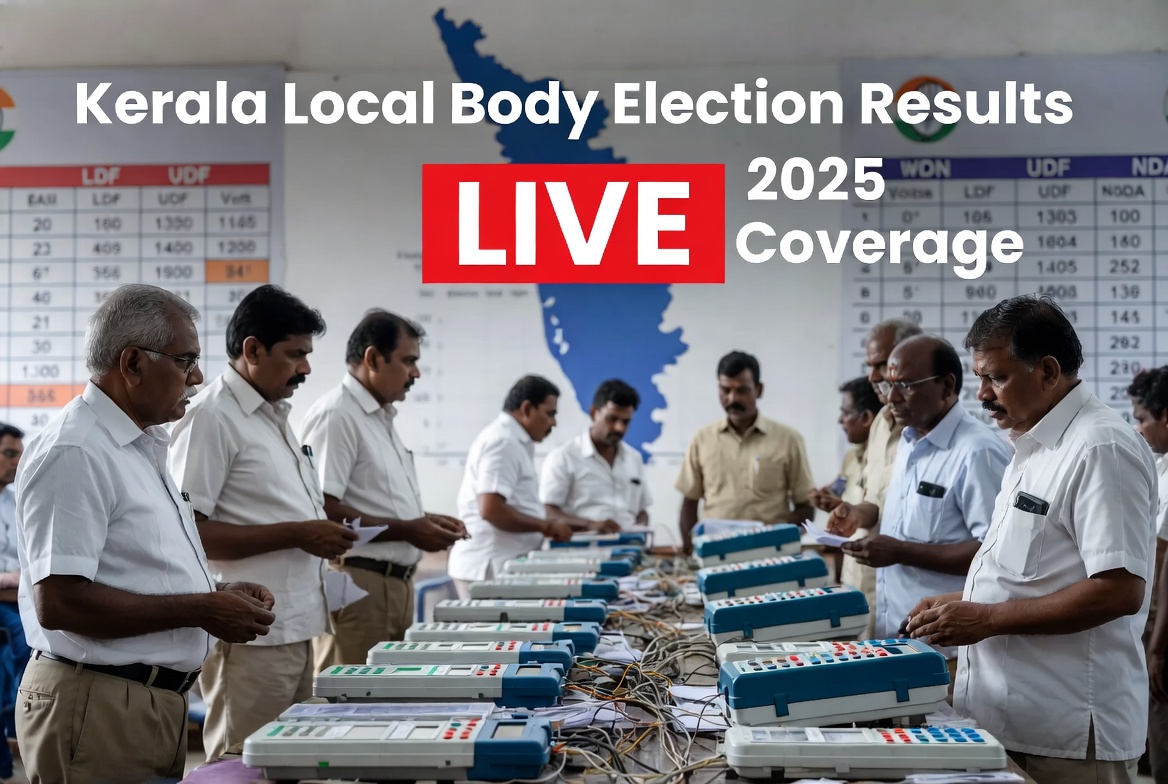
The Kerala Local Body Election Results 2025 have become one of the most discussed political moments in the state this year. Millions of voters across Kerala turned out in large numbers to elect their representatives for Panchayats, Municipalities and Corporations in elections held in two phases on December 9 and 11, 2025. Vote counting began on December 13, 2025, and the results are being watched closely by political analysts, residents and parties alike, as they could offer early signs of what to expect in the 2026 Kerala Assembly elections.
Table of Contents
ToggleHigh Voter Turnout and Its Significance
Kerala witnessed a strong voter turnout in its 2025 local body elections. Initial figures suggest impressive participation from the electorate, showing that people across panchayats, municipalities and corporations were deeply invested in selecting leaders who will influence governance at the grassroots level.
Observers linked this high turnout to increased awareness among citizens about local governance issues and a broader engagement in political discourse. Across districts, polling stations saw steady flows of voters from morning until evening, reflecting active public participation in the democratic process.
Counting Begins: What the Early Results Suggest
The long-anticipated moment arrived when vote counting started early in the morning on December 13. Postal ballots were counted first, followed by counting of Electronic Voting Machine (EVM) votes. By mid-morning, preliminary data showed a close contest among Kerala’s three major political fronts: the Left Democratic Front (LDF), the United Democratic Front (UDF), and the National Democratic Alliance (NDA).
Across 1,199 local bodies for which elections were conducted, the LDF, UDF and NDA showed leads in different areas. Early trends shared by the State Election Commission indicated that each front was leading in various wards in grama panchayats, block panchayats, municipalities, and corporations, highlighting how competitive the Kerala local body election results were.
Trend Highlights: LDF, UDF & NDA Performance
The trending pattern of results showed each front making gains and facing challenges across the state.
In Panchayats, the traditional stronghold of the Left Democratic Front showed strong leads in several gram panchayat areas. At the same time, the UDF was not far behind, eyeing potential wins in a number of local units. The NDA also made its presence felt, but with relatively fewer leads compared to the two dominant fronts.
When it came to Municipalities, trends varied district by district. The LDF made significant inroads in many municipalities, while the UDF also showed growing strength in urban centers. Longer counting updates suggested that while the LDF had the upper hand in many municipal wards, the UDF was steadily closing the gap.
In Corporations, which include major cities like Kochi, Thrissur, and Thiruvananthapuram, the competition was intense. Reports indicated that the UDF was leading in several corporations, including Kochi, where it crossed the required majority by winning more than the needed seats. In Thiruvananthapuram Corporation, the NDA made headlines by securing notable leads, even challenging the LDF’s traditional influence there.
Thiruvananthapuram Corporation: A Historic Moment
One of the most talked-about developments in the Kerala local body election results was the NDA’s performance in Thiruvananthapuram Corporation. Early on, the alliance led by the BJP managed to secure 50 seats, putting it on the verge of winning the mayor’s chair in the state capital, a seat historically dominated by other political fronts. Such a development is being interpreted as a potential shift in political dynamics at the urban level.
This result gained even more attention as it was accompanied by a symbolic win by R. Sreelekha, the first woman IPS officer from Kerala to enter politics, who secured her division’s seat in Sasthamangalam. Her victory was widely reported and added to the narrative of shifting political winds in the local governance landscape.
Panchayat Trends: A Close Battle
In the panchayat election results, both the LDF and UDF were seen trading leads in different regions. Gram panchayats and block panchayats showed fluctuating numbers, with neither front able to pull decisively ahead in many rural areas. The NDA, though smaller in numbers here, did manage to capture some seats, hinting at expanding support beyond its traditional bases.
This trend points to a competitive political environment where rural voters are engaging actively with electoral choices rather than defaulting to long-standing loyalties. For political strategists, these results are significant as they could indicate voter priorities at the grassroots ahead of larger state elections.
Municipal and Urban Insights
In urban local body results, including municipalities and corporations, the UDF was seen as performing strongly in several centers. In places like Kochi and Thrissur, the UDF leads suggested that city voters were leaning toward Congress-led governance in civic institutions.
Experts noted that urban voters tend to focus more on development issues, civic amenities, and administrative efficiency. The local body election results showed that these factors could have influenced voting behavior, with parties emphasizing local issues in their campaigns.
How to Check Kerala Local Body Election Results Live
For voters and followers who want real-time updates on the Kerala local body election results 2025, the official portal of the State Election Commission Kerala provides live trends and detailed results. The Commission’s trend software allows users to view ward-by-ward results, majority standings, and updates as counting progresses.
Besides the official site, many national and regional media outlets also offer live updates, highlighting key leads and notable winners as the counting evolves throughout the day.
What These Results Mean for Kerala Politics
The Kerala local body election results 2025 are not just about local governance. They are seen by many political analysts as a litmus test for the mood of the electorate ahead of the 2026 Kerala Assembly elections. High turnout, close contests, surprising wins, and shifts in traditional strongholds all point to a dynamic political environment.
The strong performances by the UDF in cities, the resilience of the LDF in many panchayats and municipalities, and the visible gains by the NDA in selected urban pockets are likely to shape campaign strategies of all major fronts as they prepare for the next big electoral battle.
Moreover, the active participation of new candidates and voters’ willingness to explore alternatives has added fresh momentum to Kerala’s political narratives in 2025. This could have implications for how parties position themselves on statewide issues such as economic development, social welfare, education and infrastructure.
Conclusion
The Kerala Local Body Election Results 2025 have brought forward a fascinating mix of trends, surprises and competitive politics. With Panchayat, Municipality and Corporation results showcasing diverse voter behavior, the state’s political map appears more fluid than in past elections. Whether the early leads translate into final victories, or how these results affect the larger state political landscape, remains to be fully seen as counting continues and official outcomes are confirmed.
Stay tuned for more detailed updates and insights as the Kerala election results unfold and as analysts work to decode what this means for the future of governance in Kerala.